
Stocks of Indian companies with exposure to Europe fell on Tuesday amid concerns about the impact on their sales in case the Russia-Ukraine crisis worsens and the US and its allies impose economic sanctions on Russia. While top conglomerates, including Reliance Industries, the Tata group, and Aditya Birla Group, said they did not have any significant exposure to Russia, executives of some of the oil and gas, pharmaceutical, and tea companies said they were monitoring the situation closely as they earned substantial income from the region. Russian President Vladimir Putin on Monday ordered troops into two breakaway regions of eastern Ukraine after announcing that Russia would recognise their independence.

Though early days, meteorologists point towards a neutral La Nina during the initial phase of the four-month monsoon season this year that starts from June. If this holds true, by the time the rains hit the mainland, it could mean there would be one less reason to worry about the prospects of the monsoon this year. Weathermen said making any accurate prediction of how El Nino will behave and what impact it can have on the progress and distribution of rains is difficult to say at this point. A clear picture will emerge around late May or early June.

As part of the exercise, each family will get complete ownership of the businesses it manages while scrapping the holding company.

'We have all the technologies available, but it should be converted to something that can be commercially viable.'

The Centre has, perhaps for the first time, decided to provide funding support to farmer-producer organisations, krishi vigyan kendras, custom hiring centres, and individuals for purchasing them.

Banks and companies in India are taking a cautious approach towards Sri Lanka, which, reeling from a financial crisis, has sought a $1-billion loan from the country to import essential commodities. A senior State Bank of India (SBI) executive said the bank was committed (to Sri Lanka) for the long term. "As far as exposures (are concerned), the bank will be cautious on its dollar exposure to Sri Lankan entities till the situation improves," he said.

After raising Rs 10 crore in seed funding last week from investors like Paytm founder Vijay Shekhar Sharma, Freshworks founder Girish Mathrabootham and Silicon Valley based venture capitalist firm Hourglass Venture, Chennai-based social media startup Pepul told Business Standard that it is looking to raise around Rs 200 crore by June this year for expansion. The social media platform, focused on online ethical practices, will be launched by 1,000 entrepreneurs across the country on January 26. Pepul, founded by G Suresh Kumar, will be using an Aadhaar-based user verification system to get rid of fake accounts on its platform. "We are planning to raise around Rs 200 crore by June this year.

'We were exporting copper at that time. Now India is importing copper to the tune of around $1.2 billion. Moreover, there was a larger impact on the dependent MSMEs.'

The government's food subsidy in the ongoing fiscal year is expected to be a little less than Rs 4 trillion.

Kerala-based Kitex Garments, the world's second-largest children's garments producer, has landed in trouble after sporadic violence at its workers' camp led to an attack on the local police, injuring at least five officers. The local police told Business Standard that at least 156 migrant workers were detained after the incident and around 50 have been arrested so far. A decision on any possible action against the company will be taken after the investigation.

Factionalism between OP Panneerselvam and Edappadi Palaniswami, the dominance of the BJP, the ruling DMK having a strong face in the form of CM Stalin, 'community and region-based politics', corruption charges against former ministers, and lack of a proper ideology are the major challenges the party is facing in the state.

Backed by the China-plus-one policy, India's textile and apparel exports have seen a 53 per cent growth during the April-November period of the current fiscal year at around $26 billion. This compares to the figure of $17 billion during the same period in FY21. According to Wazir Textile Index, all major companies including Welspun, Vardhman, Trident, KPR Mills, Indo Count, RSWM, Filatex, Nahar Spg and Indorama have posted higher sales during the first half of the current fiscal year compared to the pre-pandemic year.

With innovations such as the introduction of new variants and the launch of tetra packs, Mohan Meakin (MML) aims to achieve a record high sales of around 10 million units of Old Monk in 2022. From almost 3 million units a few years ago, sales volume has rebounded substantially. "Today, we are over 8 million units and are targeting record sales of 10 million next year," said Vinay Mohan, the director of Mohan Meakin (MML). Mohan said the company had started giving franchisees in states where tetra packs have good sales.

'Kerala is on a par with global standards.'

The cinema industry is staring at a loss of at least Rs 5,000 crore at the box office over the next six months if Omicron proves to be a spoiler.

The spread of the Omicron variant of the coronavirus has made Indian companies persist with their policy of banning overseas trips and allowing only essential travel within India. The IT services firms, which had planned to ask their employees to return to the workplace, are also waiting and watching the Covid-19 situation before fully opening up their offices. Large conglomerates like the Tatas, Birla, JSW and Reliance are continuing with the mandatory social distancing and masking policies within their office premises.
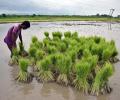
Among the key demands of agitating farmers has been a legal guarantee on minimum support price (MSP). The protest reached a crescendo when thousands of farmers from Punjab and elsewhere marched towards Delhi late last year and decided to block the main entry points once they were denied entry. The Centre, on its part, held 11 rounds of discussions with the protesters and even offered to amend some of the provisions without much success. With now one of their chief demands met, farmers have now moved on to force the government to concede on MSP.
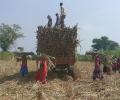
Nitin Tyagi is a young farmer in Budhagaon village of Baghpat district of Uttar Pradesh. A few years ago, Tyagi left his fairly lucrative job in the medical industry and shifted base to his ancestral village to look after his land and property. He opened a small shop selling farm inputs in the village and also started taking a greater interest in agricultural matters which had so far been looked after by his father and uncles. Tyagi and his brothers primarily grow sugarcane, potato and wheat on nearly 10 acres of land with sugarcane taking up most of his time and effort. Being one of the most important and lucrative cash crops of the region, sugarcane is directly linked to the fate of millions of farmers in west UP and with it, the electoral fortunes of political parties seeking their votes in the coming assembly polls.
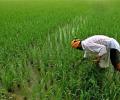
Gross value added in agriculture and allied activities clocked a healthy growth rate of 4.5 per cent at constant prices in the second quarter of FY22, up from 3 per cent during the same period last fiscal year and 3.5 per cent in Q2 of 2019-20. In the first quarter of FY22, gross value added in the sector was also 4.5 per cent. Growth in current prices was also a healthy 7.9 per cent in July-September 2021-22, up from 7.3 per cent in the same quarter last fiscal year. It was slightly less than the 8.7 per cent of the second quarter of 2019-20.

The Centre, after the repeal of the farm Acts, may bring in another important piece of legislation concerning farmers in the form of the long-pending Seeds Bill. This will be in the ogoing winter session of Parliament. Sources said the draft Seeds Bill, in the way it was prepared in 2019, sought to overcome several of the shortcomings of the Seeds Bill of 2004, which was proposed to replace the Seeds Act of 1966. However, the 2004 Bill could not be cleared owing to deficiencies in it.
 © 2025 Rediff.com - Investor Information - Advertise with us - Disclaimer - Privacy Policy - Sitemap - Feedback - About us - Terms of use - Grievances